
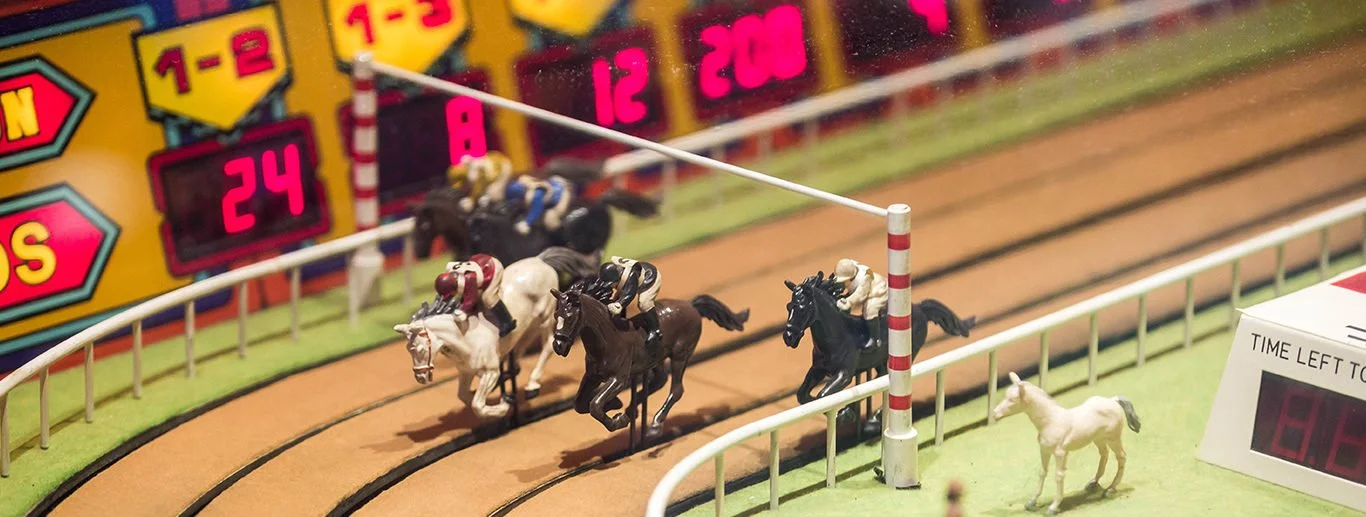
When you arrive on the second floor of The D Las Vegas casino on Fremont Street, you're greeted by the tinny, rhythmic thumping of 20 artificial hooves galloping in unison. It's louder than it has any right to be. It's more compelling than anything nearby. And it belongs to a machine that is, by any rational casino calculation, not worth keeping.
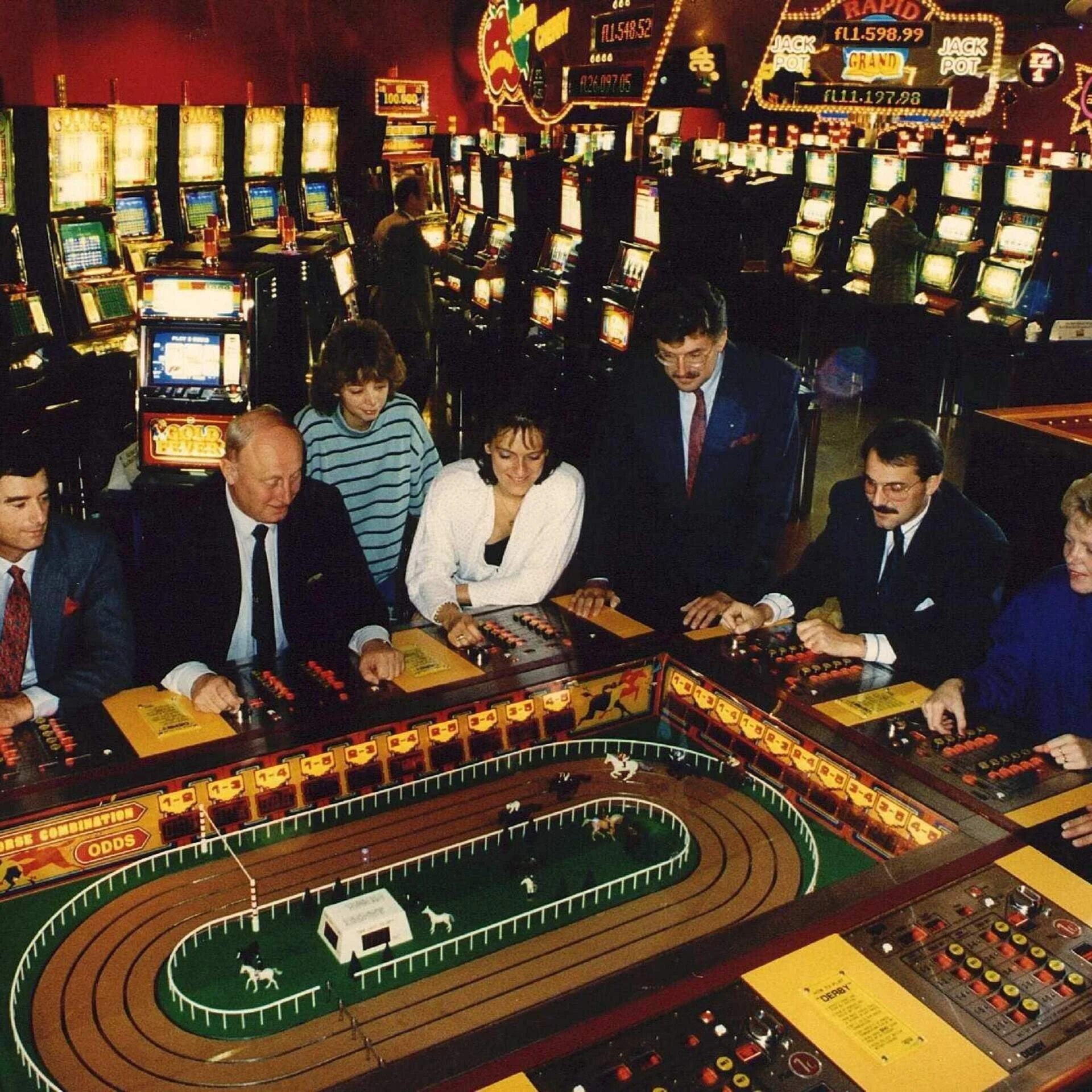
The Sigma Derby is an electro-mechanical horse racing game manufactured by Japanese company Sigma Game Inc., introduced in 1985. The rules are simple enough for anyone who has already enjoyed a number of complimentary drinks to follow: a series of odds ranging from 2-1 to a maximum of 200-1 are displayed before each race. You have 30 seconds to insert your quarters and place your bets on one of ten possible quinella combinations — which two horses will place first and second. Then you cheer on your chosen ponies as an elaborate series of gears hurtles them around a miniature track for 60 seconds.
That's it. No touchscreen. No progressive jackpot. No player's card slot. Just five plastic horses, a roll of quarters, and ten strangers rooting in the same direction.
For years there was one inside most Las Vegas casinos. They were a fixture of the casino floor the way cigarette machines and keno runners were — background noise that you didn't notice until it was gone. And then, gradually, it was gone. Modern machines took over. The economics didn't work. A slot executive who worked Strip casinos at the time put it plainly: "You could never make any money on it. People could play at a quarter a time, you watch those horses race around 30 seconds, then they place a quarter again. You could sit there with a $10 bill for two, three, four hours."
One by one, the machines were retired. Parts became scarce. Technicians who knew how to work on them aged out. By the time anyone thought to preserve one, there was almost nothing left to save.
Almost.
The first slot machine Derek Stevens ever played in Las Vegas was the Sigma Derby, at the Dunes Hotel in the 1980s. He got a beer, got a roll of quarters, and fell in love. When Stevens bought the downtown property that would become The D Las Vegas in 2012, bringing the Sigma Derby back was not a business decision. It was a personal one. He and his team eventually tracked down a machine in northern Nevada or northern California — he no longer recalls the specifics — that had been out of commission for some time. It required a complete refurbishment. Getting it approved by the Nevada Gaming Control Board took additional time and effort.
Finding technicians with the skills to maintain a largely analog 30-year-old machine is nearly impossible. Locating parts — usually extracted from the remains of other Derbys — is becoming increasingly difficult. "We've bought a lot of parts off of eBay over the years to keep the horses running," Stevens has said.
The effort has been worth it. Despite the fact that the game doesn't make The D much money, it has become the casino's most popular attraction. "It's a game where everybody can play together. Everybody's rooting together," Stevens said. "There's a lot of camaraderie, a lot of fun." People fly to Las Vegas specifically to play it. Couples make it their annual pilgrimage. One regular comes in every day and calls it his retirement plan.
Robert Piechowiak, who worked for Sigma Game Inc. for close to 13 years, described it as "the true first social game where you could sit alongside other people and participate in the same game, drink and gamble, and see the person across from you rooting for the same horses." In an industry that has spent forty years trying to engineer isolation — one player, one screen, one experience — the Sigma Derby accidentally became the most social thing on the floor.
There is a myth, told and retold at The D, that if the first bet of your Vegas trip goes on the Sigma Derby, you'll be luckier for the rest of your stay. Nobody can prove this. Nobody seems interested in disproving it.
Field trials of a new Sigma Derby are planned for Las Vegas in 2026, in partnership with Next Gaming, and may land at either Four Queens or Binion's. Whether a new version captures what the original has is an open question. The wood-paneled cabinet, the analog gears, the sound of quarters dropping into a metal hopper — some of that may not survive the translation into something modern and manufacturable.
For now, the horses are still running on the second floor of The D. Bring quarters.
